Your New Patient's History Isn't in the Referral
Date Published
Sep 23, 2026
Written by
Consolidate Health
Time to Read
4 min
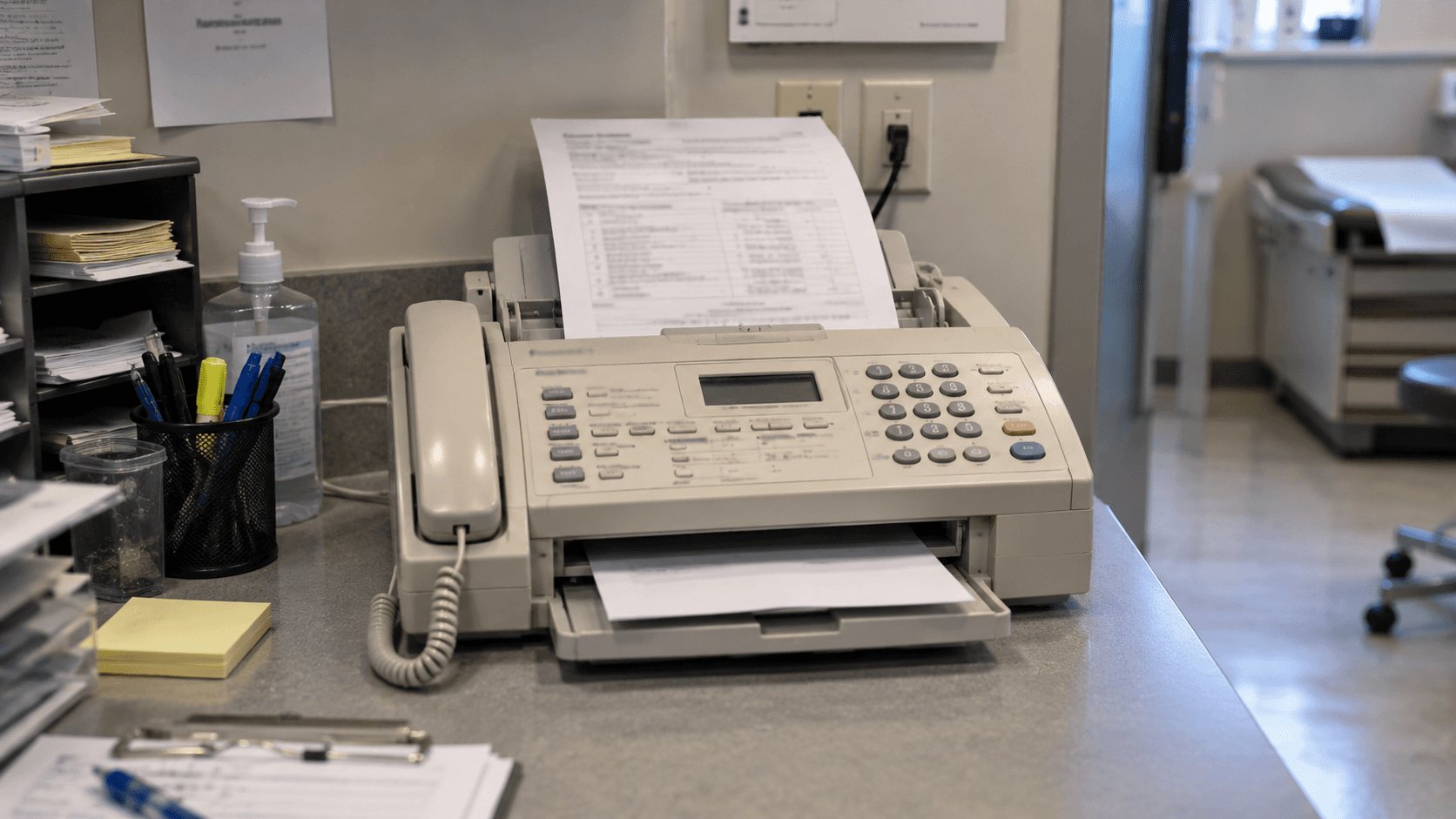
A new patient is scheduled for next Tuesday. Between now and then, the practice assembles what it can.
A referral packet arrives by fax from the referring physician. The patient fills out an intake form, either on paper in the waiting room or through a digital tool beforehand. Maybe someone calls a prior office and requests records. By Tuesday morning there's a folder.
And while what's in the folder is real data, it's also a specific and fairly narrow slice of what exists, and the shape of what's missing is predictable enough to be worth naming.
What a Referral Packet Actually Is
The referring office is sending what's relevant to the referral. If they're referring for a cardiology consult, they send the cardiac workup. That's the correct behavior, and it's what you'd want them to do, but it also means the packet is scoped to the referral question rather than to the patient, and the person doing the scoping can only see their own practitioner chart anyway.
So two filters have already been applied before anything arrives; the referring provider sent a subset of what they hold, and what they hold is a subset of the patient's care that happened to occur under their roof.
Everything from providers not involved in this referral is absent. The endocrinologist the patient has seen for six years, the hospitalization from their move two states ago, the urgent care visit where a medication was started; none of those offices know this referral is happening.
The Intake Form Has a Different Problem
Intake forms route around the provider entirely and ask the patient. That's a genuinely different source, and it can catch things no records request would.
It also inherits everything about human recall. Patients misremember medication names and reliably misremember doses. They compress timelines. They forget providers they saw a few times years ago, which, as we've written about, are disproportionately the specialists. They report a diagnosis in the words someone used in conversation rather than the words in the chart.
Put the two sources together and you have what one provider chose to send plus what the patient could recall. Both useful, but neither is the full record.
Why This Is Worst Where It Matters Most
Someone seeing a dermatologist for a rash probably has a history that fits comfortably in a referral packet. Someone arriving at an oncology practice has usually been through imaging, biopsy, pathology, and consults with several physicians, often across more than one organization, sometimes over years. Their history sits with multiple prior providers, and the referral packet represents only one of them.
The specialties with the most prior providers per patient are the specialties where a missed medication, a prior adverse reaction, or a previous treatment attempt changes the plan. Oncology, cardiology, neurology, complex chronic disease. The completeness gap is widest exactly where its consequences are largest.
There's a workflow cost too. Whatever the practice doesn't receive, someone has to chase down. Staff have to call prior offices, wait, re-fax, and follow up, and the patient gets asked the same questions again. That work happens whether or not it succeeds.
What Completing the Record Requires
The patient authorizes it. Their right to their own records is established under the 21st Century Cures Act, and that right reaches every provider they've seen, not just the ones participating in this referral. That's the mechanism that gets past the structural limit above: the patient can reach their whole history, and no individual office can.
Then it has to arrive as data rather than as documents. A stack of image-based PDF still doesnt solve the issue of getting the patient's record, it just relocates it for uptake later. Structured clinical data can instead be piped in as discrete elements and circumvent this issue.
And the attachments have to come along. Progress notes, imaging reports, procedure notes, discharge summaries. As we covered a few weeks ago, that's where the reasoning lives, and for a new patient it's frequently the only place anyone recorded why a previous treatment was stopped.
If You Build Intake or Referral Software
The point worth making is that this is additive rather than competitive with what you already do.
Your fax parsing captures what was sent. Your intake forms capture what the patient knows. Neither of those is replaced by retrieving the rest of the history, because neither was ever trying to do that job. Together they produce something none of them produces alone, which is a practice that has the full picture before the patient walks in.
It's also a capability you can offer to customers you already have. You're in the workflow at the exact moment the record is needed, you have the distribution, and the practice already trusts you with this part of their operation. Adding retrieval underneath doesn't require a new sales motion, just a better answer to a complaint your customers are already making.
The Framing We'd Suggest
Practices don't experience this as a data problem. They experience it as a scheduling problem, a staffing problem, and a "Tuesday-morning" problem.
But the thing making Tuesday hard is that the information required to treat this patient exists, in full, in several systems that have no reason to talk to each other and no idea the appointment is happening. The patient is the only party with the right to reach all of it.
If you'd like to learn more about Consolidate Health's API and how we retrieve a complete longitudinal record, book an intro call today.
If you prefer to try the product with zero commitment, you can request sandbox access.