Building an AI Health Coach? The Data Layer You're Missing
Date Published
May 19, 2026
Written by
Consolidate Health
Time to Read
4 min
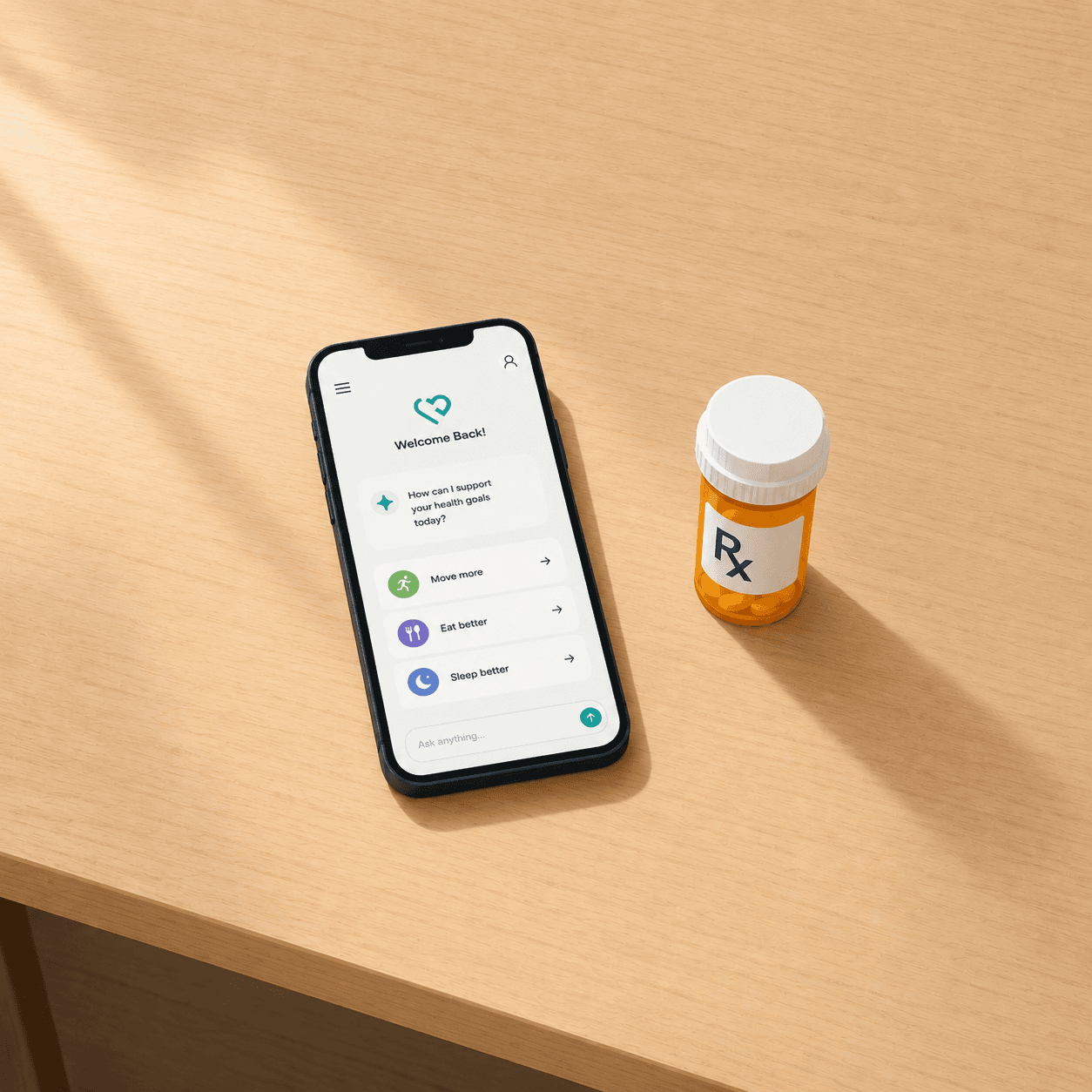
AI health coaches are one of the hottest categories in digital health. The promise is compelling: personalized health guidance powered by AI that actually understands your situation.
The reality for most of them: they're working with limited data and making generic recommendations as a result.
The missing ingredient isn't better AI. It's better data access.
The Personalization Problem
Real personalization means accounting for a user's specific medical conditions, current medications, lab values and trends, allergies, medical history, and active treatment plans.
Now consider what most AI health coaches actually know about their users: self-reported information (often incomplete), wearable data, questionnaire responses, and maybe data from a few connected apps.
The gap between what personalization requires and what most coaches actually have is significant.
Why Self-Reported Data Falls Short
"Just ask users for their health information" seems like the obvious workaround. It doesn't hold up in practice.
Patients forget things; most people can't accurately recall every medication they've taken in the past year, including dosages. Patients don't know things; current A1C, eGFR, LDL cholesterol aren't numbers most people track. Patients simplify things; "I have high blood pressure" doesn't capture severity, specific diagnosis, or how well it's controlled. And information changes; a questionnaire from six months ago is already outdated. Medications change. Labs shift. New conditions appear.
Self-reported health data is a rough sketch. Medical records are the detailed picture.
What Clinical Data Actually Enables
With access to a user's clinical records, an AI health coach can deliver guidance that's genuinely different:
Medication-aware recommendations: Know what drugs the user takes, understand interactions, and tailor advice accordingly, don't recommend supplements that conflict with their prescriptions or suggest activities their medications contraindicate.
Condition-specific guidance: An AI coach that knows about a user's diabetes gives different exercise guidance than one that doesn't. Same for heart conditions, autoimmune disorders, or any documented condition.
Lab-informed insights: Connect wearable patterns to clinical markers. "Your glucose has been elevated lately, and your A1C has trended up over the past year" is more useful than "your glucose seems high."
Medical history context: A user's response to a health question looks completely different if the AI knows about a surgery three years ago, a relevant family history, or a past diagnosis that's since resolved.
Change detection: When medications change or new diagnoses appear, the coach can proactively adjust its guidance rather than operating on stale information.
The Difference in Practice
Same user, same question about cardiovascular health. Two different coaches.
Without clinical data:"To improve heart health, consider regular cardio exercise, a Mediterranean diet, stress management, and quality sleep. Aim for 150 minutes of moderate activity per week."
Generic. Reasonable. Applicable to almost anyone — which is another way of saying it's not really personalized at all.
With clinical data:"Given your hypertension and the beta blocker you're taking, here's what to consider: your medication affects heart rate, so tracking exertion by heart rate will underread your effort — use perceived exertion instead. Your recent labs showed elevated LDL, so the Mediterranean diet is especially relevant; focus on omega-3 fatty acids. Your potassium was at the low end of normal; worth discussing with your doctor whether dietary changes might interact with your blood pressure medication."
That's the difference clinical context makes. Not a better model. Better data.
The Technical Challenge
Accessing clinical data means integrating with EHR systems such as Epic, Cerner, athena, and others. That involves understanding FHIR APIs and healthcare data standards, implementing OAuth flows for patient authorization, building connections to multiple EHR vendor platforms, normalizing data across systems, and maintaining integrations as APIs evolve.
For AI companies focused on model development and user experience, this infrastructure work is a significant distraction from core product value.
The Data Layer
This is what Consolidate Health provides. Our API delivers patient-authorized clinical data from major EHR systems in clean, normalized formats. Integrate once and your AI coach gains access to current medication lists with dosages, active diagnoses and problem lists, recent and historical lab results, allergy and adverse reaction information, immunization records, and care team information.
You build the AI. We handle the data access.
It's also worth noting the regulatory tailwind here. The HTI-5 proposed rule explicitly supports AI applications accessing patient data, updating definitions to allow autonomous AI to retrieve and share health data and advancing "AI-enabled interoperability solutions." Regulators recognize that AI healthcare applications need data access to be effective — the legal framework supports it.
The Competitive Reality
AI health coaches that rely solely on self-reported data and wearables will hit a ceiling. Their personalization is bounded by what users remember to tell them.
Coaches with clinical data access offer something categorically different; medication awareness, lab-informed insights, guidance that reflects what a doctor actually knows about the user. As the category matures, that distinction will be obvious to users. One coach knows them from a questionnaire. The other knows them from their medical record.
The data layer isn't a nice-to-have. It's the difference between generic and genuinely personalized.